
Spring
Absolutely. A useful way to organize your notes is to think of Spring as an ecosystem, not as a single framework.
1. Brief history of Spring
The problem Spring was created to solve
In the early 2000s, enterprise Java development was largely based on J2EE. Building enterprise applications often involved a lot of configuration, heavyweight application servers, and tightly coupled components.
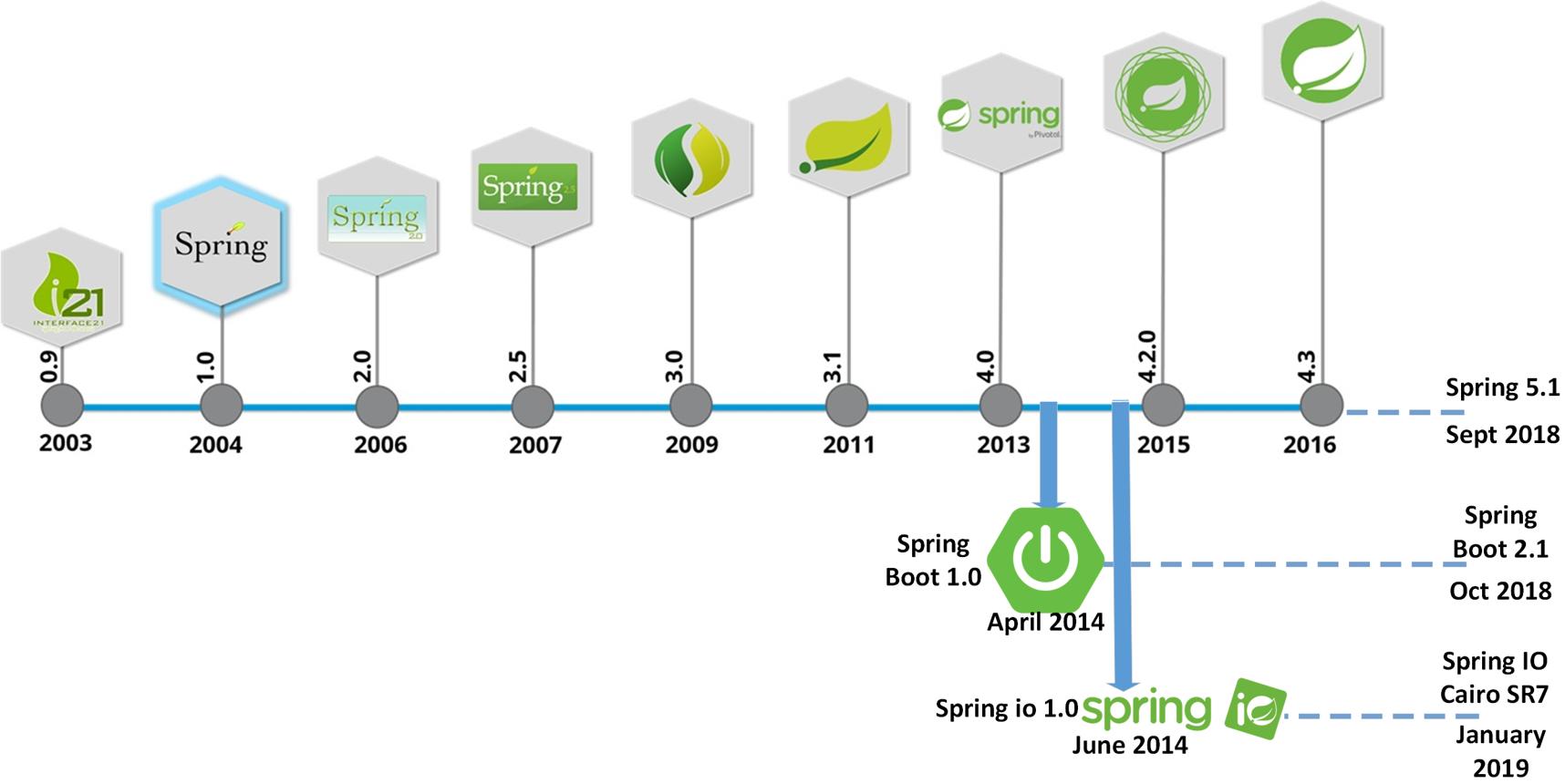
Spring began in 2003 as a response to this complexity. Its central idea was:
Keep application/business logic simple and let a framework handle the infrastructure.
The original Spring Framework emphasized Inversion of Control (IoC) and Dependency Injection (DI), allowing objects to receive their dependencies rather than constructing them themselves. (Home)
Simplified evolution
| Period | Development | Why it mattered |
|---|---|---|
| 2003 | Spring Framework begins | Alternative programming model to heavyweight J2EE |
| 2004–2008 | Spring becomes widely adopted | DI, AOP, transactions, JDBC, MVC, testing |
| 2009 | SpringSource acquired by VMware | Spring gains significant commercial backing |
| 2013 | Spring Boot introduced | Dramatically simplifies Spring application setup |
| 2014+ | Spring Cloud | Spring becomes heavily used for microservices/cloud |
| 2010s | Spring Data, Security, Integration, Batch mature | Spring expands beyond web applications |
| 2020 | Spring Framework 5.3 / Boot 2.x era | Mature cloud-native ecosystem |
| 2022 | Spring Framework 6 / Boot 3 | Java 17 baseline, Jakarta EE transition |
| 2024–2026 | Boot 3.x → 4.x, Framework 6.x → 7.x | Continued modernization, AOT/native, observability, AI, modular architecture |
The important conceptual progression is:
Spring Framework → Spring Boot → Spring ecosystem
Spring itself describes its ecosystem as modular: you can use only the projects you need. (Home)
2. What exactly is "Spring"?
This causes a lot of confusion when learning Spring.
There are three meanings commonly referred to as "Spring":
Spring Framework
The core framework.
It provides things such as:
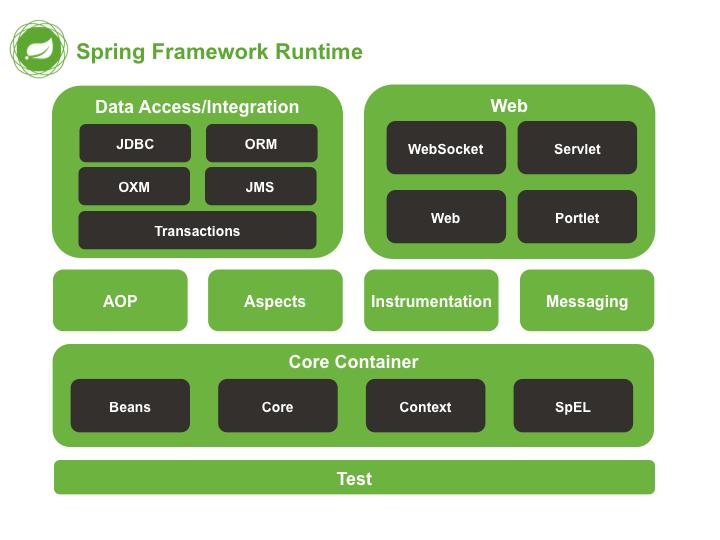
- Dependency Injection / IoC
- Application Context
- AOP
- Transaction management
- Spring MVC
- Spring WebFlux
- JDBC support
- Validation
- Scheduling
- Caching
- Testing support
(Home)
Spring Boot
A layer built around Spring Framework that makes it much easier to create and run applications.
It provides:
- Auto-configuration
- Starter dependencies
- Embedded servers
- Externalized configuration
- Production features
- Actuator
- Easy executable JAR deployment
- Minimal configuration
For example, instead of manually configuring a web server and many Spring components, you can create a Boot application and run:
java -jar my-application.jarSpring Boot's goal is explicitly to provide a fast, opinionated starting point while allowing you to override those defaults when necessary. (Home)
Spring Ecosystem
Everything around the Framework and Boot:
                    Spring Ecosystem
                           │
             ┌─────────────┴─────────────┐
             │                           │
     Spring Framework              Spring Boot
             │                           │
             └─────────────┬─────────────┘
                           │
       ┌──────────┬────────┼─────────┬──────────┐
       │          │        │         │          │
    Security    Data     Cloud    Integration  Batch
       │          │        │         │          │
    GraphQL     Kafka    Gateway    AMQP        AI
    Session     Mongo    Config     etc.
3. The major Spring projects
Here is the part I'd recommend putting directly into your notes.
A. Spring Framework — the foundation
Purpose: Core programming model for Java applications.
Main capabilities:
- IoC / Dependency Injection
- Beans and ApplicationContext
- AOP
- Transaction management
- Spring MVC
- Spring WebFlux
- JDBC support
- Validation
- Scheduling
- Caching
- Testing
- WebSocket
- HTTP clients
Think:
"The foundation on which most Spring applications are built."
(Home)
4. Spring Boot — application development
Purpose: Make Spring applications easy to create, configure and deploy.
Important features:
Auto-configuration
Spring Boot examines your dependencies and automatically configures appropriate components.
Starters
Instead of individually finding many dependencies:
spring-web
spring-webmvc
jackson
validation
...
you can use a starter such as:
spring-boot-starter-webEmbedded server
A web application can contain its server rather than requiring deployment to an external application server.
For example:
Spring Boot Application
       │
       ├── Your code
       ├── Spring
       ├── Tomcat/Jetty/etc.
       └── Dependencies
Actuator
Provides production-oriented capabilities such as:
- Health checks
- Metrics
- Application information
- Monitoring endpoints
Externalized configuration
Configuration can come from:
application.properties
application.yml
Environment variables
Command-line arguments
Configuration servers
Spring Boot is therefore the project you will encounter in most modern Spring applications. (Home)
5. Spring Data — database access
Purpose: Simplify access to databases and other data stores.
Spring Data provides a consistent programming model while still allowing each database technology to retain its specific capabilities. (Home)
Major subprojects include:
- Spring Data JPA
- Spring Data JDBC
- Spring Data MongoDB
- Spring Data Redis
- Spring Data Cassandra
- Spring Data Elasticsearch
- Spring Data Neo4j
- Spring Data R2DBC
- Spring Data REST
For example:
public interface UserRepository
        extends JpaRepository<User, Long> {
}
You can then perform operations such as:
userRepository.findById(id);
userRepository.findAll();
userRepository.save(user);
userRepository.delete(user);
Spring Data can also derive queries from method names:
List<User> findByLastName(String lastName);So:
Spring Data = abstraction and convenience around data access.
(Home)
6. Spring Security — application security
Purpose: Authentication and authorization.
It handles things such as:
- Login
- Authentication
- Authorization
- Password handling
- Roles and authorities
- Method-level security
- OAuth2
- OpenID Connect
- JWT/resource-server security
- CSRF protection
- Security filters
Conceptually:
Request
   ↓
Spring Security
   ↓
Authenticated?
   ↓
Authorized?
   ↓
Controller
Example:
@PreAuthorize("hasRole('ADMIN')")
public void deleteUser(Long id) {
    ...
}
Spring Security is the standard Spring project for securing applications. (Home)
7. Spring Cloud — distributed systems / microservices
Purpose: Solve common problems when applications are distributed across multiple services.
For example:
             API Gateway
                  │
        ┌─────────┼─────────┐
        ↓         ↓         ↓
    User       Order     Payment
   Service    Service     Service
        │         │         │
        └─────────┼─────────┘
                  ↓
             Config/Infra
Spring Cloud provides tools around patterns such as:
- Configuration management
- API Gateway
- Service-to-service communication
- Circuit breakers
- Service discovery
- Distributed messaging
- Cloud/platform integration
- Kubernetes integration
- Distributed application patterns
Important Spring Cloud projects include:
- Spring Cloud Config
- Spring Cloud Gateway
- Spring Cloud Circuit Breaker
- Spring Cloud OpenFeign
- Spring Cloud Kubernetes
- Spring Cloud Stream
- Spring Cloud Bus
- Spring Cloud Function
(Home)
Think:
Spring Boot builds the service; Spring Cloud helps the services work together.
8. Spring Integration — enterprise integration
Purpose: Connect different systems and applications.
Imagine:
File
 ↓
Spring Integration
 ↓
Validate
 ↓
Transform
 ↓
Send to REST API
 ↓
Publish message
 ↓
Database
It implements well-known Enterprise Integration Patterns using messaging and adapters. (Home)
Useful when you need:
- Message routing
- Transformation
- Filtering
- Adapters
- Polling
- File integration
- HTTP integration
- Messaging workflows
9. Spring Batch — batch processing
Purpose: Process large volumes of data in jobs.
Example:
10 million records
       ↓
     Reader
       ↓
    Processor
       ↓
     Writer
       ↓
   Database
Typical use cases:
- Importing CSV files
- Generating reports
- Processing millions of records
- ETL
- Data migration
- Scheduled jobs
- Financial processing
Spring Batch provides infrastructure for robust, restartable batch jobs. (Home)
10. Spring for Apache Kafka
Purpose: Integrate Spring applications with Apache Kafka.
Instead of working directly with low-level Kafka APIs, Spring provides familiar abstractions.
Typical architecture:
Producer
   ↓
 Kafka Topic
   ↓
Spring Kafka Consumer
   ↓
Business Logic
Useful for:
- Event-driven architecture
- Asynchronous processing
- Streaming
- Microservice communication
- Event sourcing patterns
Spring's project catalog describes it as providing familiar Spring abstractions for Apache Kafka. (Home)
11. Spring AMQP
Purpose: Messaging through AMQP-compatible systems, especially RabbitMQ.
Example:
Producer
   ↓
RabbitMQ
   ↓
Consumer
Spring AMQP provides Spring abstractions for AMQP-based messaging. (Home)
Think:
- Spring Kafka → Kafka
- Spring AMQP → RabbitMQ / AMQP
12. Spring GraphQL
Purpose: Build GraphQL APIs using Spring.
Instead of a REST API such as:
GET /users/123
GET /users/123/orders
GraphQL allows clients to request the data they need through a GraphQL query.
Spring for GraphQL integrates Spring applications with GraphQL Java. (Home)
13. Spring Session
Purpose: Manage HTTP sessions independently of the servlet container.
This becomes particularly useful in distributed applications:
             Load Balancer
                  │
        ┌─────────┴─────────┐
        ↓                   ↓
   Server 1              Server 2
        │                   │
        └─────────┬─────────┘
                  ↓
             Redis/DB
           Session Store
This allows session information to be shared across multiple application instances.
Spring Session provides APIs and implementations for managing user session information. (Home)
14. Spring HATEOAS
Purpose: Build REST APIs following the HATEOAS principle.
Instead of returning only:
{
  "id": 10,
  "name": "John"
}
the API can also provide links describing possible next actions.
{
  "id": 10,
  "name": "John",
  "_links": {
    "self": {
      "href": "/users/10"
    },
    "orders": {
      "href": "/users/10/orders"
    }
  }
}
Spring HATEOAS provides support for creating REST representations following HATEOAS. (Home)
15. Spring Modulith
Purpose: Build modular monoliths using Spring Boot.
This is particularly interesting if you don't want to immediately split an application into microservices.
For example:
E-Commerce Application
│
├── customer
├── order
├── payment
├── inventory
└── notification
All can remain in one deployable application while being organized into well-defined modules.
Spring Modulith helps verify module boundaries, test modules independently, observe module-level behavior, and generate documentation around the modular structure. (Home)
Think:
Spring Modulith = structure a monolith like a collection of well-defined modules.
16. Spring AI
Purpose: Build AI-enabled applications using Spring.
It provides abstractions for integrating:
- AI models
- Enterprise data
- Vector databases
- Retrieval-Augmented Generation (RAG)
- AI tools/function calling
- Chat applications
- Embeddings
The Spring project catalog describes Spring AI as an application framework for AI engineering, particularly connecting enterprise data/APIs with AI models. (Home)
17. Other useful Spring projects
The Spring ecosystem is much larger than the projects above. The official catalog currently includes projects such as: (Home)
| Project | Main purpose |
|---|---|
| Spring Framework | Core Spring programming model |
| Spring Boot | Build/run Spring applications easily |
| Spring Data | Database/data access |
| Spring Security | Authentication & authorization |
| Spring Cloud | Distributed systems & microservices |
| Spring Integration | Enterprise integration/message flows |
| Spring Batch | Large-scale batch processing |
| Spring Kafka | Kafka integration |
| Spring AMQP | RabbitMQ/AMQP messaging |
| Spring GraphQL | GraphQL APIs |
| Spring Session | Distributed/user session management |
| Spring HATEOAS | HATEOAS REST APIs |
| Spring Modulith | Modular monolithic applications |
| Spring AI | AI/LLM application development |
| Spring for Apache Pulsar | Apache Pulsar integration |
| Spring LDAP | LDAP integration |
| Spring Shell | Command-line applications |
| Spring REST Docs | REST API documentation |
| Spring Web Services | SOAP web services |
The official project catalog is the best place to keep track of the current ecosystem because individual Spring projects have independent release cycles and repositories. (Home)